
The Madhuri Gupta episode shows Pakistan's Intelligence Bureau is back from a relatively long hibernation, writes security expert B Raman
Madhuri Gupta, the indian diplomat arrested for spying in the Indian mission in Islamabad, may not have access to sensitive information, but she has access to the high commission and could have planted transmitting devices and tapped phones, writes B Raman.
All the three improvised explosive devices of low sophistication planted outside the Chinnaswamy stadium in Bengaluru where an IPL match was played on Saturday afternoon would appear to have been planted in the open space outside the stadium after the anti-explosive sanitisation had been done thrice by the police. B Raman's discerning take on the incident:
What was the role of Rehman Malik, the present interior minister and a close confidante of Zardari, who had been nominated by Zardari as her security officer on behalf of the Pakistan People's Party? He was responsible for liaison on behalf of the party with the officials of the Musharraf government who were co-ordinating the security arrangements.
Set up an auxiliary intelligence corps like the territorial army or the auxiliary air force. It should consist of part-time volunteers for intelligence collection by people in other professions who want to or are willing to help the intelligence agencies. Their links with the intelligence agencies must be protected by making the training course a short one and on an one-to-one basis, instead of holding it in a class where everyone becomes aware of the identities of others.
The CRPF and local police on anti-Naxal operations perform a thankless job but a few basic counter-insurgency measures could have prevented the deadly Dantewada attack, writes B Raman.
The available details regarding the fidayeen attack on the United States consulate in Peshawar, the capital of the North-West Frontier Province of Pakistan on Monday, are still confusing.However, certain aspects of the attack are clear: It was a single target swarm attack, meant to penetrate the US consulate in a manner similar to the penetration of the General Headquarters of the Pakistan army in Rawalpindi in October last year.
Al Qeada-backed Chechen separatists may have been behind the Moscow suicide blasts. Security expert B Raman examines the surge in terror in Central Asia.
The Pakistanis play quid pro quo diplomacy better than India does. They know how to promote their national interests while taking advantage of the needs of the US in the Afghaistan-Pakistan region, notes B Raman.
All governments indulge in spin. One should not, therefore, blame the government of Dr Manmohan Singh for indulging in spin in the case of David Coleman Headley, of the Chicago cell of the Lashkar-e-Tayiba, and for trying to mislead the hapless Indian public with the help of obliging journalists that the plea bargain entered into by the Federal Bureau of Investigation with Headley was not a setback, but a great triumph for Indian diplomacy.
Now that David Headley has pleaded guilty, it is settled that he will not be extradited to India and that India will not be allowed to interrogate him.
Unless one is naive beyond redemption, it was clear from the beginning that the Obama Administration and its FBI were trying frantically to prevent the truth regarding Headley from coming out, writed B Raman.
It would be futile to expect that Saudi Arabia could be of assistance to India in dealing with jihadi terrorism emanating from Pakistan or Bangladesh. There has been a long history of links between jihadi terrorist elements in India and Saudi Arabia ever since the demolition of the Babri Masjid in December,1992
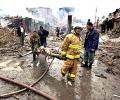
B Raman explores if were Indians the specific target in the Kabul blasts, which killed six Indians and 11 others on Friday.
At the end of the talks with Salman Bashir, Pakistani Foreign Secretary in New Delhi on Thursday, Nirupama Rao, the Indian counterpart, projected the initiative taken by India in proposing the meeting between the two countries as a prelude to a wider dialogue at different levels on various contentious issues -- though not necessarily in the form of a reversion to the composite dialogue process to which Pakistan continues to be attached.
Foreign Secretary Nirupama Rao and her Pakistani counterpart Salman Bashir will be meeting at New Delhi on February 25,2010, under a face-saving formula which would enable both the governments to claim that the respective stand taken by them after the 26/11 terrorist strike in Mumbai stands vindicated by this meeting.
In September-October 2008, the Mumbai police had arrested four IT-savvy members of the Indian Mujahideen, who had played a role in sending e-mail messages in the name of the IM before and after the Ahmedabad blasts of July 2008, and before the New Delhi blasts of September 2008, by hacking into wi-fi networks in Mumbai and Navi Mumbai. Three of them were from Pune
India needs to evolve a comprehensive security machinery with clearly laid down concepts, carefully defined leadership roles and a workable co-ordination drill.
B Raman recollects how VP Singh was taken for a ride at the taxpayers' expense when he was prime minister
While re-vitalising these interactions, it should be our endeavour to expand the basket of issues of concern to India, which have arisen since the format of the composite dialogue was agreed upon when Atal Behari Vajpayee was the prime minister and which are not discussed specifically now, writes B Raman.
